This trip has been more fruitful and easier than I anticipated. I was cautious and a bit too lethargic before taking off—I had reserved tickets months in advance and in the meantime a lot has happened. It also meant I had to stop writing for another 10 days. I still don’t know what the research-related outcomes are, but for sure it has been an intellectual, emotional, and spiritual restart for the last few days. My Paris “home,” Nadine and Ben, are always extremely generous and making it easy to land. I met Nadine’s parents, both of which have a very refined taste of contemporary dance. Her father’s passionate way of talking about performance renewed my faith in what I am studying; her mother has an amazing memory of shows from 20 years before. I wish there were more people like them.
I saw Mette Ingvartsen’s Moving in Concert the night I arrived. I was jetlagged, but it oddly helped me appreciate the piece more. I had another jetlagged Mette experience when she was in NYC with 21 Pornographies and I came back from Ghent to see it, another “spinning fluorescent light” piece and probably a segway for her to the new series she is now embarking on. I was probably more receptive to the light and sound vibrations, my body more permeable to the subliminal manipulations because I was tired, sleep deprived, and out of circadian-sync (plus, the attack of memories from the time before I was at Pompidou to see Mette’s 7 Pleasures). This is a more concerted and distilled way of using the ordinary stimuli we are subjected to everyday: the LED billboards, bluelight screens, city noise, wireless signals, and policed motions of human bodies-rendered-populations. But this kind of interpretation is the easier way out regarding what’s happening. What is always baffling to me with Mette’s works, and here too, is how she manages to create an originally sensual corporeality and imagery out of these minimalist choreographic principles and material tools, all the while driving a critique about them and through them. I can’t think of anything more arousing than the image of burning bodies in volcanic ash and lava after this.
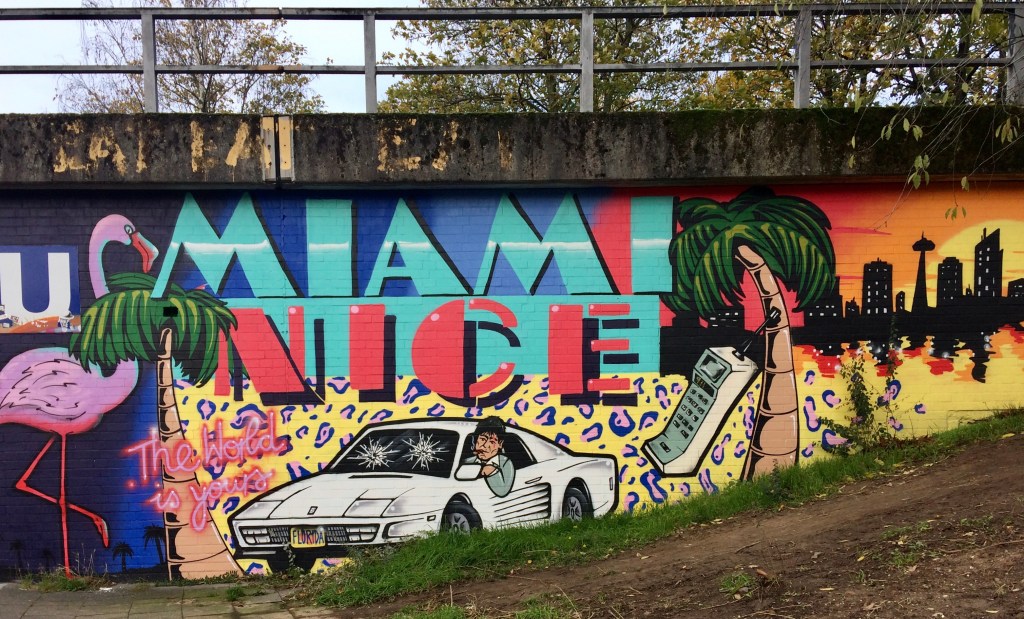
Next up, I visited Mirza and Hicran in their Koln home. They are bored out of their heads and want to move to Berlin soon. Our exilic condition never rules out our vulnerability to loneliness, if anything it multiplies that. And then we exile ourselves further, never knowing where to land. No Protestant soil can soothe our starving Mediterranean souls. The dinner ended with youtubing Hicran’s uncle’s band and some traditional wedding music that uses clarinet (rightly) instead of zurna.
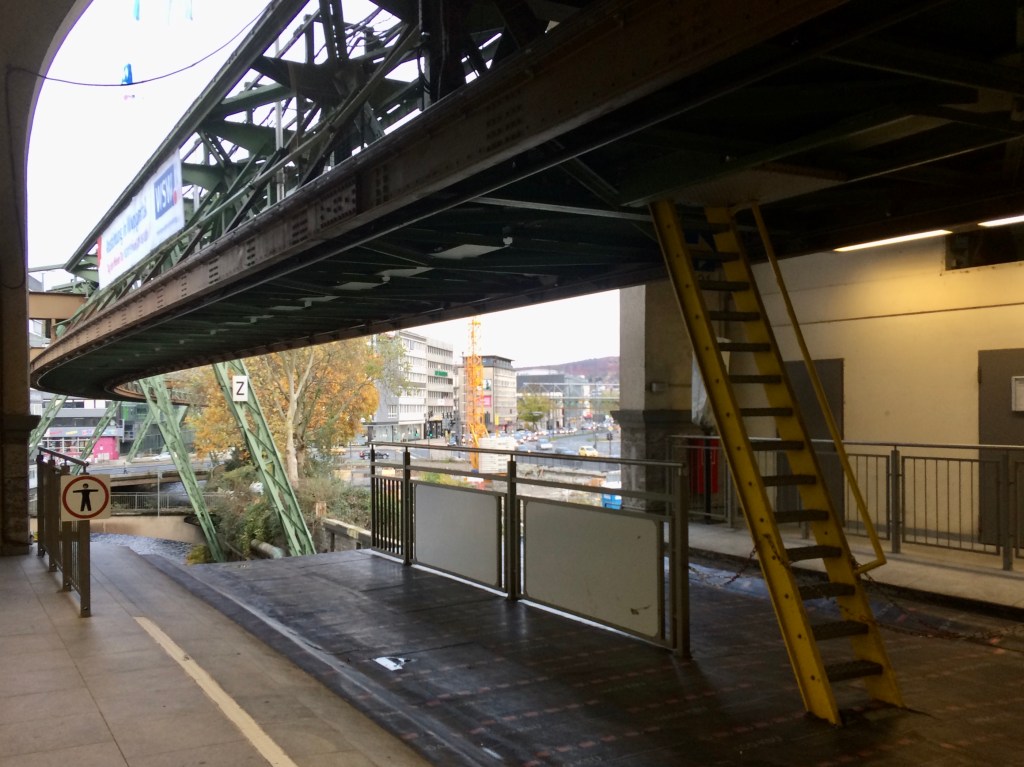
As soon as I got off Barmen-Wuppertal train station next morning, I headed to Pina Bausch Foundation. Ismael and Alen were already waiting for me; they saw me walking in the courtyard and smiled from the window. Those smiles were my reassurance that everything would work out. Both of them remembered my visit from last year (and probably with an appropriate giggle at my clumsy attempts to break in to “THE ARCHIVES”). They kindly shared the background on the archive work they’ve been doing for the last 9 years. I found it necessary to repeatedly tell them how important it is for folks in so many parts of the world to see her work even from video renditions. They will launch an online archive in June 2020. Just last week they have released Palermo Palermo to test the waters.
The first day I had a blast with Blaubart. The whole idea of DJing with Bartok on a record player on stage is crazy for today, let alone for 1977, and this is the smallest praise I can give. Nelken is of a different phase of her experiments, which I didn’t know and was positively surprised about. Komm Tanz Mit Mir feels much earlier, ultra theatrical in comparison, but one can already see her main compositional strategies and the bittersweet tone that only she knows how to strike.
It is one thing to read about her dramaturgical paths that alter in time or drift synchronously. It is a whole other thing to experience it as an all-round change of her expressive universe. Even from grainy videos this tectonic shift can be transmitted under the skin.
My selection from Foundation and Tanztheater Wuppertal was based on my readings and Pina’s stage designer Peter Pabst’s interview with Wim Wenders. I wasn’t sure what exactly I’d find, and I can happily report that I didn’t find what I’d assumed to. In a not-so-clever way I picked pieces eclectically divided in time, and it was interesting to see ruptures, continuities, undercurrents, modulations across her phases of exploration. I knew of the two major trajectories in her aesthetic, what I will call the early tragic-choral phase (terrible shorthand but bear with me, I am thinking of it compositionally), which she is better known for (Cafe Muller, Rite) (Turk arabeskligine de en cok hitabeden donem bu *swh). The other trajectory is the episodic city pieces she did through the 1990s and 2000s. The signs were already there for me to see, but only now, with the accumulated hindsight of pieces across decades, do I have a sense of her punk-blues that feels very pre-1989 Germany, that out-Brechts alienation, that ruthlessly divides the core of every motion and emotion to the nth degree to see how any human expression can be possible.
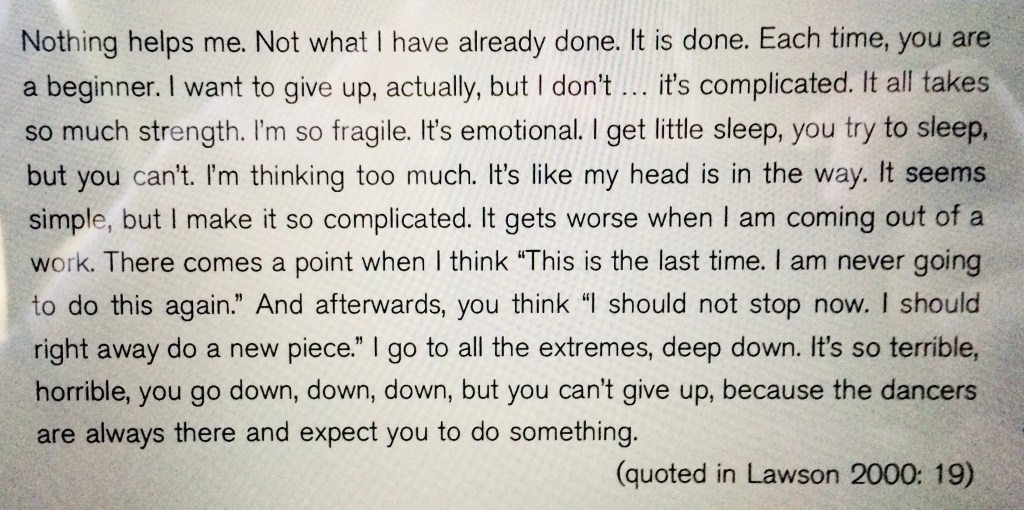
This vision completely changed the way I could grasp Wuppertal as a place and what it might have meant for Pina’s artistic discipline and focus (as well as her fellow artists’). It was powerfully illuminating about what it means to form a pack and make a pact, to retreat from crowds and centers, to endure limitations, to choose a home and not fidget. Just 4 days with limited Internet and human interaction reminded me so much about what it was like to pay hardcore attention and stay with an intensity with my whole being and not seeking low-level, meaningless, even sensationless diversions. This also relates to the question of exile, boredom, and creativity, but I can only draw lessons for myself here.
I made other surprise connections in this visit, with Laser, a second generation Turkish-German who works at Tanztheater Wuppertal’s management, and with long-time company member (and really a black box) Benedicte Billiet. They made this parachuting in much friendlier and enlightening in ways I couldn’t have imagined.
I couldn’t run in the park near the place I stayed, but I was lucky to have a clear fullmoon sky. And some other rites to fulfill this pilgrimage. May we lose ourselves and find anew.
The best part of traveling to Germany (gurbet alert) is the Turkish markets and products. This will be my friendsgiving dessert for Dino (aka gurbetlik insana zehir bile yedirtir):

 Eylül Fidan Akıncı