devamlılık ne demek bilmiyorum. sırf kendim için yazmaya başladığım o zamandan, yazmayla yavaş yavaş gelen kendinden eminlikten ve coşkudan sonra dev bir kesinti. gezegen boyutunda bir arıza. birazcık da susmayı iyi bir şey saydığımdan olsa gerek, genellikle, sustum. ama çoğunlukla yeni bir “şey”in içinde olduğumuz için, eskiden getirdiğim dil ve düşüncenin uyumsuz, yetersiz, kendini eğleyen hali acınasıydı. hala öyle. hayatımın en sıcak yazı olması, yangınlar, sonunda derimin altına girmiş olan siyasi rehinelik durumu, yaşanacak bir ülke ve hatta dünya kalmayacağı fikri bile, bu kesintinin yarattığı panik ve mide bulantısının yanında hafif kalıyor. görünürde her şeye kaldığım yerden devam ettim: tez yazmaya, ders vermeye, (oturmak beni sakat bıraktığında bile) hareket etmeye, hep bir kısmıyla uzağımda kalan arkadaşlarıma mesajlar değiş tokuş etmeye. ama bir şekilde olduramıyorum, yani kendimi çok acemi hissediyorum, eskiyi sürdürdüğüm her an yalan söylüyorum, -miş gibi yapıyorum, isildemekten tıkanıyorum. çok şaşkın ve dehşet içindeyken, herkes nasıl kendinin bir hayaletini geleceğe doğru uzatıp esnetmeye çalışıyor ve sakince bu hususta işbirliği yapıyor, nasıl çığlık atmıyoruz beraber, anlamıyorum.
sanki artık şablonlaşmış avantgardist kırılma ve devrim düşleri de yok. elimizden alındı. değer dengesizliği iyice açıldı. galiba değişimlerin bir sıçramaya dönüşebilmesi için insanların bunu hem münazara etmesi hem de bir şekilde zamanın o beklenmedik yarılışının içine birlikte girip birlikte manevra alması gerekiyor. ama öyle çokuz ve öyle yalnızız ki.
Deniz, on the phone, lets off a groan hidden in a giggle: “I just need some people to say ‘I don’t know.'” “At least begin with ‘Not sure but maybe…’,” I add. In the midst of an inflation of digits, words, unknowns, cases, exceptions, possibilities, and conspiracy theories, we both feel that this is a cognitive crisis more than anything. Yet there is perhaps one silver lining to this problem of knowing: Everything that existed previously before the planetary pause has now a different dimension, space, and uncriteria to be contemplated. Other kinds of counting and reading have become possible, if you can get over a rushed nostalgia, that is.
During the third week of February, when “virus” still had the distance of a metaphor for my part of the world, I was to facilitate a workshop for dance and ballet students on undoing and reconstructing the dance history. I was particularly seeking a way for us to tell multiple stories for dance through the cracks in its unproblematically institutionalized, unsurprisingly Eurocentric, appropriating, and progressivist narrative; trying to fill the gigantic gaps across, say, louis quatorze, dalcroze-delsarte, petipa-fokine-nijinsky, duncan-fuller-denis, graham-lemon-cunningham, rainer-paxton-brown, laban-wigman-jooss-bausch, atdk-vandekeybus, forsythe-mcgregor, bel-le roy… which is, the entire world? I don’t want to sound smug, it has been a challenge for me too to articulate what makes a dance theatrical or concert dance, what kinds of choreographic practices are considered critical-conceptual-artistic-experimental enough, and what my criteria and terms are for locating any dance that is not these. I use shorthands but I always feel their thorns and dents.
That same week I saw Queen Blood by Ousmane Baba Sy a.k.a. Babson and Paradox-Sal crew and it touched on all these sore points in my stretches to get another way to think about dance history: How they begin with an open, improvisational preamble and formalize gradually. How the choreographic structure allows us to familiarize the house vocabulary through the duration of the performance, but how each body is unique in the way they interpret-inhabit-increase this vocabulary. How complex, intricate, and well-codified that vocabulary has grown across decades in the ways it mobilizes the feet, legs, hips, torso, spine, and neck. How robustly it allows one to modify a gesture or improvise a state of un-knowing. How these bodies are dealing with pure movement too, whatever that is, from within “unrecognized” languages and punctuations that stretch at least an ocean. How the design and lighting techniques render the bodies hieroglyphic and two-dimensional at times, how they give back their density and volume, and what these shifts can mean about being a body versus being an image. How the house music provides various possibilities to movement, such as emotional commentary, polyrhythmic framing, temporal anticipation, rupture and layering. How beautiful it is to watch bodies watching each other dance. How wondrous it is to watch women watch each other dance separately and dance together. How moving it is to see them call and respond in movement and in shouts of dare and swag. How pleasurable it is to watch virtuosity without shame(ful appropriations and memories of violently disciplined bodies).
How do you transform the condensed collective energy of a “popular” dance to concert stage? How do you dramaturge its movement repertoire and micro narratives for theatrical space, time, and spectatorship, while respecting its authenticity without stultifying it into a timeless form and without fetishizing its living contexts? Queen Blood is the best answer I have seen so far to these questions, and of course more. And we no longer have any reason why we should consider a work like this in a distinct category from an ATDK piece, given they are all thinking about what else bodies can do, how else movement can converse with music, and how choreography has become a layering practice full of chance encounters.
Maybe these questions are useless and I am behind the curve. Maybe it is only me, my own mental habits that I am forcing to un-learn. Maybe everybody else is already more flexible and fluent in aesthetic code-switch, and can find an equivalent vitality and criticality across the embodiments of north south east west theatre street studio bedroom. Or maybe not, and maybe all these gestures and swings of limbs will implode into our collective body and mix together and by the time we emerge out from our quarantines we will be ready to flatten the vertical HIStory of dance and Queendom will lead the parade.
All this rumination on history aside, Queen Blood‘s house extravaganza returned me to the mad ends of my passion for dance. The watching part and the doing part both. What else does a choreographic performance have to do, for real? Thanks to my angelic hosts I was given three bacchanal nights with a hundred amazing dancers from all around the world. I would perish in this narrow body-room by now if I hadn’t taken all of them.
I would have loved to be able to present this penultimate part of the puzzle I have kept lingering on, with the proper words to accompany the images I gathered. But a new form of life has outviralled the linguistic cognition. Isolation is the easy part; our neurological paths are being corroded through this matter of unknowability, despite our futile attempts to keep business as usual virtually. It is a problem of code. There is a big black hole now where I stored my tentative connections between ideas and things, the fabric of the world as I knew, the physical and metaphoric landscapes that I inhabited. I am back to my mother’s home for an indefinite time, and all I want to do is just to get at some sense of completion, even if it is weak and fake. There are already way too many interpretations of the pandemic condition, already too many things to consume under curfew. I won’t pretend this is one of those. This is more of an attempt to retain some personal memories from before my awareness of this “event.” An event that expands in reverse, not onward and outward from its reverberations and afterimages but toward its own ever-approaching threshold. Yet, anything I might write now will inevitably be impregnated with the sovereign RNA.
I was thinking of Brazil. Not only because of Jatahy, but also while reading an article on Pina Bausch’s relationship to South America for research, as well as through four other performances I saw in 2019. I also recently saw an announcement that Crowd would tour to Brazil. These were all less than two weeks ago, while we still could plan bodies to come together.
Lia Rodrigues’ Fúria @ Kunstenfestivaldesarts. Its last 5-10 minutes was a little bit of a didactic monologue about the colonialist legacy that, for me, didn’t do more than what went down until that ending: The rhythmic chant-like music makes one imagine that it is coming right from the Amazon, which of course slaps your very colonialist imagination to your face. The dancers are sometimes shaking insanely to this rhythm, sometimes forming groups that may or may not have ethnographic source material, or sometimes breaking formation into small triangles and duos and moving across the stage in a slow parade of a nonhuman royalty.
In the same festival, I also saw Marcelo Evelin’s A Invenção da Maldadeand Alice Ripoll & Suave’s Cria. Evelin’s felt like a live installation with audience in the round, where naked bodies activate a sort of ritual with wood and salt. Cria abstracts a fusion street dance from favelas, called dancinha, to bare proscenium stage. And what connects Fúria to Maldade to Cria is not their geographic coincidence. During all three, I felt the redundancy of the fact of watching dancing bodies from the auditorium or in the gallery. They shared an oscillation between ultra-presence and abandonment in the pleasure of continuous movement: a consistent but modulating mixture of rhythm, stomp, shake, chant, a critical/fake/invented “primitive” imaginary, the sense of frenzy, the nudity and skin in its sexual and nonsexual expressions, gender fluidity, the body’s glorious strength and endurance, all to discover propositions about freedom. If Brazil overdetermines these works politically/dramaturgically, it is through the question of the materiality of human and the corporeal definitions of liberty (which we now ask as a question of immunity). Instead of watching, I just wanted to join these multitudes and merge and disappear in their all too coded and self-coding motions. There is something more happening here than just “durational” or “ritualistic” or “postdramatic.” These choreographies are showing multiple vectors of how biopolitics is investigated and overturned in performance [though perhaps this is outdated already, as McKenzie Wark asks a few days ago: “Can we go back to biopolitics?”]
That moment in Fúria when all dancers are in a frenzy of touching toppling looking at each other with passion hunger outrage, I couldn’t help thinking of Gisèle’s Crowd and Mette’s to come (extended) and 7Pleasures. The juxtaposition reveals a difference one might expect from a banal comparison between these colonized vs colonizing worlds. But what Gisèle and Mette did with the bodies they collected is the most honest thing they could do. Their pieces generate very strong affects too, but it happens only by way of watching. I have to look from a distance; the image that travels and the sound vibration that hits assault my bodily security and stability, but by virtue of definitively not joining in. They too design choreography as a flow but plan carefully calculated cuts to that flow, which is eventually what one ends up appreciating and feeling more.
Between these constellations I experience a personal schism, on the one hand wanting to run with the pack and dance in the communal delirium and loving the sensual and aesthetic extravaganza it promises, and on the other hand deeply admitting how impossible, belated, unaffordable our fantasies of ecstasy are in the late-capitalist perversions.
A month later, Bárbara Wagner and Benjamin de Burca’s film-installation for the Brazilian Pavilion at the Venice Biennale, Swinguerra, made this dilemma even more blatant. It was the only artwork in the entire biennial that Erika and I responded to viscerally. But I had to keep looking at the projection screen, and not to the art crowd in designer sale clothes swinging the biennale catalogue as a hopeless fan, to be able to do that. I was also annoyed by my own pleasure of it, which was a result of this by now pretty systematic re-packaging of “street” dance forms for the art and fashion worlds. Although the crews that danced in this short film had a say in how they were being filmed, I still think that there is a difference with a choreographer approaching other fellow choreographers and dancers to work out ways of bastardizing and disseminating these highly virtuosic and vital motions in a new performative context than visual artists reframing them for–let’s face it–market circulation.
Can you tell the difference? I will try in the next and final chapter, if I don’t lose language entirely by then.
UPDATE: The problem of staging the ecstasy and erotics of dancing together started, for me, with Uruguayan choreographer luciana achugar’s An Epilogue for OTRO TEATRO: True Love from December 2015. Funny that I just remembered it while looking for a good long house dance set to shake myself out of depressed curfew inertia. Also to this day, her Pleasure Practice workshop is still the most physically appealing and creatively triggering movement class I have ever taken.
3 hour of dancing extravaganza to an amazing set. Just play it full screen and dance fuck cook pray clean the door handles vacuum the floors brush teeth take shower wash the dishes fold the laundry move your toes stretch your tissues scratch your dog’s back to it.
I am slowly pacing forth into talking about a transformative week I had in Hamburg, which made the accumulation of past seven years legible for myself for the first time. But I can’t help delaying the pleasure and taking byways that will make it even more meaningful–for the personal narrative but also dramaturgically.
There are (at least) six ATDK moments that fold into this.
First pleat: It is 2013 June. ATDK comes to Istanbul and wants to go to Taksim Square in person to see the occupation. We think she is totally badass to do that, especially given that other big names in show business are cancelling their Istanbul gigs. “Luckily” she coincides with a beautiful moment in which people throw carnations; she stays there until about an hour before the show, Rosas Danst Rosas. She later interwove this episode to her thoughts on walking/dancing: “Les philosophies orientales considèrent communément que pensée profonde et mouvement sont incompatibles. Néanmoins, dans certaines pratiques bouddhistes, il est possible de méditer en étant mobile. Je pense que My walking is my dancing est une manière d’être en mouvement dans la ville. Je me souviens encore des images du mouvement de protestation à Istanbul où les manifestants se tenaient debout, silencieusement, sur la Place Taksim. Leur geste était moins un geste d’opposition qu’un geste de questionnement.” [The eastern philosophies usually consider deep contemplation as incompatible with movement. However, in certain buddhist practices, it is possible to meditate while being mobile. I think that My walking is my dancing is a manner of being in movement in the city. I remember the images of the protest movement in Istanbul, where the demonstrators were standing, silently, on the Taksim Square. Their gesture was less about opposition than one of questioning.] Before Rosas Danst Rosas ends, people begin checking their phones, leaving the salon, and of course it is not at all about their impatience with serialist abstractions. The police attacks again and everybody is worried, the immediate urge is just to go there, with or without their friends’ at risk in Taksim. So much for buddhism.
Second pleat: It is 2011 September, Istanbul. I have watched this choreography from 30 years ago, Fase, Four Movements to the Music of Steve Reich, many times on video, but now it is live and the baroness herself dancing it. What is most beautiful is the mistakes she is making with a grin, or the pacing directions she is giving to Tale Dolven without needing to hide it. I begin to watch for those moments. Each night it feels like I am seeing it for the first time. And it is still very rad. The simplicity of it requires so much calculation and discipline that it would be nauseating with anybody else but not with her, not with that joyful and rebellious music. I am about the age she composed it, and I make a wish to have one hundredth of such perceptivity and serious investment in play and tenderness in whatever I might end up doing.
Third pleat: It is the Fall of 2017, Andy and I are seeing A Love Supreme at New York Live Arts. From the first moment I begin to cry with joy. I don’t even remember the choreography anymore. I don’t think I looked at it in that way, “choreography,” the design-logic that is very strong and almost like a brand for ATDK. My being turns to fluid, and the movement directly manifests the beauty of moving. The dancer/dancing is the dance, here, as the saying goes.
Fourth pleat: It is the Fall of 2013. I am seeing Cesena & En Atendant at BAM. I am not sure of the order, I am not sure of what I am seeing, but it has nothing to do with the choreographies. I remember going to a park nearby, hugging a tree–as we did in Taksim– and crying–as I had been doing so much of lately. I remember taking in the beauty of light descending into darkness with my aching eyes. It soothes my still-shaking body after the good cry. I remember loving the weird vocalizations of the dancers, wanting to join. Whatever imaginary medieval times this is, I want in. The audience is really agitated, many leave, someone shouts “We can’t see anything, turn on the lights.” I have my first cultural orientation right there and then: Americans can’t endure the possibility of impenetrable.
Fifth pleat: It is October 2016, Vortex Temporum at BAM. I am almost late to it, and perhaps a bit too lazy or tired to take myself out to the subway. But when I get there, it immediately feels like getting a gift out of nowhere. I feel a deep arousal in my inner organs; the dynamism of the motions, the holding and violent releasing of muscles do something to mine. I see the connections with the sacred geometries of Cesena & En Atendant. I hear Grisey’s music for the first time, and the piano revolving and turning around is a beautiful surprise. The interlacing circles of humans and instruments, the internal rotation of energy, squeezing in. The darkness descending again, which to my mind stands in for the glamorous sinking of an Empire. My eyes gets fixated on Boštjan Antončič, perhaps I recognize him as the only agent who goes against that implosion. The piece imprints the going off of so many bombs and boats that year.
Sixth pleat: 15 February 2020. I am at the outer right edge of the second balcony of Skirball. It is the worst and best place to be. I can stand up whenever I feel like–and whenever I do so, I feel the urge to move with whatever group choreography is happening down under. Yet I am not capable of giving in to it completely, I am thinking of the Hamburg trip I will take the next day. In order to focus, I am making an effort to internally talk to myself about what I see, describe and annotate it: “…of course it is Bach & Beautiful, but I can’t internally relate to the celebrations of European culture anymore… not out of my heart… but wait, I see a tenuousness here… there, when he stops and stares in the void… she is falling… losing balance… OK, we are still living in the same universe, ATDK and I… good good good… tenuous… tender… fallible falterable fatiguable bodies are the same as the ones that fly high… it is possible to stumble over the tapes with which she marks the geometric perfection and I am waiting for it, for the irruption of real… there is pleasure in watching someone spin, simply a childlike pleasure… I suppose the motor switches and accelerations that spinning requires is strong enough to leave its memory in the brain and it makes you re-live it by seeing it… not like a symmetrical perfect circle but more like a screw or helix, with volume…” It is another pleasure to watch Boštjan, as always. He is always panting, moving all in, nothing is saved or spared. I connect with his totally-not-occidental sense of rhythm and, for lack of a better term, animalistic way of finding oneself in movement, as much as I know that it shines forth from pure technique. His sense of nuance is so deep that he carves space like a lacework with the smallest gesture of his shoulder. When he first appears, I guess at the fourth movement, I get blurry-eyed–is it the three spotlights causing this illusion or does his monstrous way of expanding over the floor really defy the speed of perception–is he turning to vapor down in front of me? ATDK herself must have a special spot for him, since their duet is the only one that she really plays, enjoys, and let herself enter into the tenuousness she creates for others; full of lifts and changes of balance, close contact of contrasting bodies betraying sensuality and reliance. The work as a whole disrupts the music-movement relationship that one might ordinarily expect from modernist dance, and sometimes adds droplets of movement idioms from other disciplines and traditions, all of which carry Bach to an ecumenical point. But I can’t let go of the feeling “I’ve seen her do this before, there must be more.”
I was to return to this three days later.
Helal süt emmiş hayırsever bir vatandaş aşkım Boštjan’ı belgelemiş.
As I am moving on to a new chapter (Pina’s), I have been sifting through my daily freewrites of the past two years to collect the breadcrumbs of my thinking. These “ventilations,” as the academic self-help jargon calls it, capture anything that I have been thinking about performance, dramaturgy, writing, research process, anxieties… The one below is unrelated to dissertation cases, but it moved me so much with its dramaturgical composition–Christiane Jatahy’s Ithaca (Our Odyssey 1). It is perhaps distantly related to materiality question and connects to my research in that way. In any case, I remember wanting to start a dramaturgy blog back then, that night right after seeing the show. The write-up in Turkish, so I am putting the trailer as a consolation. [I just realize now that the watery aesthetics of Jatahy’s piece might be a distant offshoot of Rolf Borzik’s and Peter Pabst’s deluges on Pina’s stage]
Çapaklarını temizleme gereği duymadan…
16 Kasım 2018 // Gent
Dün biraz ani bir kararla Kristof’un önerdiği Our Odyssey gösterisine gittim, Christiane Jatahy’nin işi. Biz onun bir başka işini Hamburg’da izlemiştik–galiba yine Kristof önermişti de öyle gitmiştik. O iş gibi, bu da savaş sebepli zorunlu göç ile ilgiliydi. Yine öbür iş gibi, bu da kamera-mediated image ve görünürlük ile oynuyor; yine seyirciyle olan ilişkisini materyal düzeyde kuruyor ikramlarla. (Hamburg’da nane çayı, burada yerfıstığı ve su). Yine, biraz belgesel bir şekilde, gerçek insanların söylemlerini kullanıyor, Hamburg’da doğrudan söyleşi yaparak, burada ise 3 göçmenin günlüklerinden alıntılarla. Ama bu işin elbette metinsel ağı daha geniş, Homeros’tan alıp, Odyssey’in bir sürü güncel versiyonunu da için içine katıyor, Margaret Atwood ve birkaç kişi daha (programda yazıyor isimleri, şimdi bakamadım). Bu çok daha staged bir iş, acting ve scenography ve dramaturgy çok daha kompleks ve teatral. Diğeri bir konteynırda geçen bir söyleşi gibiydi. Almanca olduğu için çok da vakıf değildim neler olup bittiğine. Ama belki iki işin arasındaki bir başka ortaklık bu çokdillilikler ve yabancılık olabilir.
Bu işi kendi özelinde incelemek lazım aslında. Seyirciyi ikiye bölerek alıyor salona, bir yarısı Odysseus ve Calypso, diğer yarısı Penelope tarafını görüyor hikayenin. Sonra yer değiştiriyoruz, aynı akış bir kez daha oynanıyor (öte yandan sızan seslerden anlıyoruz bunu, bir de ipli perdeden sızan silüetlerden). Zaman zaman bir sahnenin oyuncuları bizim olduğumuz tarafa geçiyor, bizim tarafımızda akan sahneye uyan şeyler yapıp geri gidiyorlar. Iki adanın ortaklığını, genellikle de şiddetli jestlerden oluşan bu gel-gitleri anlıyoruz böylece. Bir yerin tecavüzü, kavgası, bir diğer yerinkinden çok farklı değil, dercesine. Ama ikinci akıştaki en önemli fark, gitgide artan ıslaklık. Iki sahnenin arasında, oyuncuların bir nevi geçiş alanı-kulis olarak kullandığı boşluktan başlayarak, gitgide ıslanıyor sahne. Su ile ilgili bir şeyler döndüğünü zaten çok başından anlıyoruz, sürahilerce su, devamlı kadeh kaldrılarak içilen sular, bardaklara dökülürken etrafa saçılan sular, Calypso’nun şarıl şarıl sahneye fırlattığı sular ilk nüvelerini veriyor. Sonra Calypso’nun yıkanışı, perdelerin arasında. Sahne artık iyice suya battığında, akvaryum, kağıt gemi, yağmur gibi öğeler de suya dair bir metafor haritasını genişletiyor iyice. Göçmenlerin günlüklerinde de delik botlar, tuzlu suda çırpınmalar, yağmurda saatlerce koşmalar. Aktörlerin sırılsıklam ıslanışı, sularda yatışı, bunun izlerken senin bedenine yaşattığı bir ürperme var.
Oyundaki şiddet beni çok etkiledi. Bedenlerin şiddeti tutuşu, uygulayışı, veya bekleyişindeki gerginlik, anilik. Bunu bir aktör olarak nasıl çalışırsın? Yani stage fight koreografisi olarak söylemiyorum. “Her an her şey olabilir” gibi bir duuyguyla bedenin gerilimle aşırı ajite ama bir yandan da sanki bir şey olmuyormuş gibi hareketsiz olması. Tam tarif edemiyorum bunu. Kaslarımın gerildiğini hissettim, yoruldum, erkeklerin tümüne karşı aşırı bir itilme hissettim. Fiziksel şiddetin gendered bir şey olduğunu da hissettirdi bu. Üç kadının sarıldığı sahne.
Işık tasarımı. Muhteşemdi. Müzik seçimleri, harikaydı. En sonunda kameraların yüze close up yaptıkları ikili sahne, ipli perdenin inişi ve projeksiyondaki yüzü bir scanner gibi tarayışı. O an çok görkemliydi. Keza kameranın aslında her kullanımı çok iyiydi. Bir yandan war photography gibi pornografik bir yere gitti bilerek (özellikle de oyuncuların kameraları oynatışını izlemenin kendisi), bir yandan da gerçekten seyirci koltuğundan görülemeyecek çarpıcılıkta imgeler kurdu (ki aslında bir öncekiyle ilişkili bu da). Sinematografik açılardı ama (hoş habercilikte de artık bunlar kullanılıyordur), documentary/newsfeed estetiğinden çok, sinematik bir estetikti.
Portekizce, fransızca. Portekizcenin yabansılığı. Bizim dilimizi konuş diye bağıran adam, ve onun Ortadoğulu yüzü.
“you can’t teach me anything behind a wall”
Bence bu iş, tam da binyıllık mitolojiler veya kurgusal bir dünyanın içine bu günlüklerden parçaları koyarak, daha efektif bir şekilde sunuyor sunmak istediğini. Derimizin altına daha çok işliyor. Nedense, “gerçek, sadece gerçek” olanı aynı kuvvetle algılayamıyoruz. Belki gerçeklik çokkatmanlı, neredeyse dağınık, ve özdeşleşilemeyecek kadar sıradan/uzak insanlardan oluştuğu içindir. Mitik hikayeler her şeyi sadeleştirir, bir duyguya/hisse odaklanır, hikayedeki insanlarsa kahraman olduklarından değil de, bir tür basitleşmiş form olduklarından, bir sembol olarak iş gördüklerinden dolayı, içselleştirilebilir hale gelirler. Işte bu basit makinanın içine gerçeği sızdırıyor Jahaty (ki burada su sızıntısı da su metaforunun uzantısı gibi… veya sahneler arasındaki sızıntı da öyle). Suriye’ye Brezilya’yı sızdırıyor okyanusları aştırarak. Hamburg’daki konteynırda haberci bir söyleşinin, bir gerçek hikayenin içine, bizim seyirciliğimizi sızdırıyordu sonunda. Ama bu kadar kemiklerimizde hissetmiyorduk işte (veya ben hissedemedim, ama dil engeli de var). Teatral makineye çok kızabiliriz, onu ilüzyon yaratıcısı olarak düşünebiliriz, ideolojik bulabiliriz. Öyle. Ama bazı gerçekliklerin, bazı güncel trajedilerin anlaşılma ihtiyacı da, belki ancak böyle bir makineyle karşılanabiliyor. Belki bu makine, haber makinesinden daha dürüst bir şekilde kendi kurgusallığını kabul edip, senin “her an her şeye ve bu yüzden hiçbir şeye” odaklanma halini biraz tedavi ediyor, gerçekliği hikayeye sarmalayıp seni de duygularınla bunun içine katarak. “Bak onlar neler yaşıyor, hayal et! Vicdan yap!” gibi bir şekilde değil de, analojiyle belki. Hayal/tahmin etmekle analoji kurmak sanırım farklı şeyler. Aslında belki kadının iki işi, bu iki farklı eylemlerle oynuyor.
I was being anal-retentive* again, hoarding on moments and words to match them, but not courageous enough to externalize them from my body. But the day is extremely strong in urging me to just get it out there, because the pile is gelling with the studious and amnesiac work of the bacteria that we commonly call time. [*Wiki says Freud said that libido energy is under-indulged during this period of time–so relevant for reasons that will become clear in the next posts]
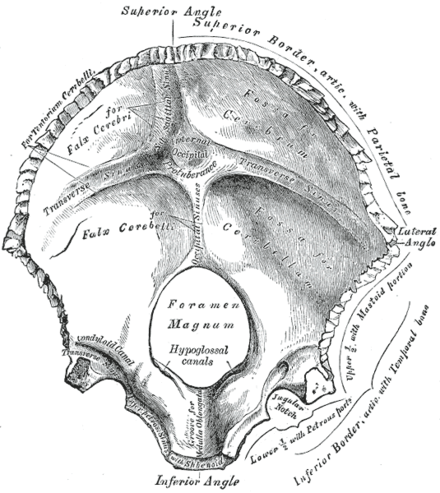
It started two weeks ago, during my second Alexander Technique class. Fabio, our Brazilian-former-Streb-dancer instructor whom all my gay friends happen to know somehow, was talking about how humans evolved to stand up and walk bipedal. He had a model skull in his hand, showing the gaping hole called foramen magnum, which traveled from the back of skull to the middle of its bottom, so that our spine–the Atlas*, our first vertebra, to be precise–could lift and balance the heavy head when we raise on our two feet. The chicken and egg relationship is unclear for me; as in any anthropogenesis myth, what causes anything and what results from it can be shifted to tell the inglorious story of our emergence differently. I had heard him say the same words the week before, but only in its iteration that his spiel reminded me of the question of animality as it was posed by Derrida and Agamben. [*The first time I heard of this vertebra was back in 2009 when I had my first movement class ever, I was in a makeshift dance studio at the top floor of an old Taksim building that was on a tiny street that bore the name of a famous Yeşilçam actor and was full of neon lights. I was very insecure and, to make matters worse, was constantly called out for how I was hunching over unnecessarily]
The animals and babies, Fabio continued, don’t calculate their movements. They don’t suffer back pain, they don’t do extra corrective or compensating motions, they don’t need to warm up. As we grow, our behaviors, beliefs, habits, traumas, emotions and thoughts creep in the way we carry our heads over our bodies. The problems in the body begin right there, in the severing of that connection between foramen magnum and Atlas, because the brain deludes itself with autonomy, I murmured in my skull. He said, “the animal and the baby is fully present in the moment.” If so, then anthropogenesis must be the destruction of the presence and totality where the brain was only an organ like any other, the severing of thinking-being from out of the body. What we call “I” is the bridge that marks the separation, perhaps “I” is the only logograph in English language that stands for the long thin fragile neck of the species named after self-knowledge. That separation of the head and the body is what allows us to stand on our feet and objectify the world within our hands and thoughts. The vision that takes the world in wide-angled plans loses sight of its own materiality, which is constantly at the brink of losing its endless negotiation with gravity. Anthropogenesis is the war you wage on your muscles for (what you think must be) transcendence. Honey, you need a sexy Alexander instructor to stop the pains of getting over yourself.
Flash back to the summer of 2017, I am staying at M’s house looking after her two cats, or rather reading The Animal That Therefore I Am and The Open under their watchful gaze. My notes from that time do not clarify if I was doing direct quotations or summaries or comments, and I am too lazy to figure it out, so take these as a choral rumination between me in 2017, me in 2020, a dead man, a living man, two cats, and a ghost:
The theological appearance of human: as autobiographical animal, “I”, speaking under his own (propre) name, giving names to other living creatures that were created before him, a chasing after which is also the genesis of time. Anthropo-theomorphic reappropriation. This is what Derrida questions, the history as the autobiography of “man.” The biopolitical reality we live in, the knowledge of and techniques over “animal” that precisely turns the alterity into “animal”, is based on the carno-phallo-logocentric autobiography.
The caesura between organic life and relational life seems to not only separate animal-plant-man, but also function as a mobile division within man. And instead of focusing on how the metaphysical conjunction of body/animal life with logos (or soul) defines man, we need to look at the practical and political ramifications of the separation within human, that separates man from non-man.
Animal theorem: something seen, but not seeing (or seeing back). Theoria, theatre, fourth wall of being. Being (Je suis, moment of autobiographical assertion of man) is following the animal. Philosophy is the calculated forgetting of that animal can look back, of absolute alterity. Derrida lists the ridiculous redrawing of divisions: thinking-consciousness, compassion-virtue, undisclosing-language, pretending to pretend, ethical responsibility.
Descartes doesn’t say that I breathe therefore I exist, but rather I think (I breathe), therefore I am. The body can be a body of a corpse or a machine, for which “therefore” cannot be the reference of existence. The presentness of the thinking to itself is the locus of existence for him. Animal and automaton are the same as each other to the extent that they cannot respond to the question of what they are (even when they react such as cry or escape when you harass them), despite they give the impression that they move, they breathe, they live. [Good for them. Fabio would think that René was right, this enlightened existence makes corpses of us who move about idiotically]
Until 18th century, until the “birth” of “human” sciences, the taxonomical work on species and language was much more entangled, different animals were suspected of speech. The Systema naturae (by Carolus Linnaeus, 18C, who were fond of primates, “Surely Descartes never saw an ape” he said), one of the first taxonomical work across species, defines Homo Sapiens as “know thyself”, and no other specific characteristics. Agamben sees this taxonomic anomaly, that is homo sapiens, as the core of “anthropological machine”. [And now I add two engineers to this machine, François Delsarte and F. Matthias Alexander, designing a somatic anthropogenesis through the 1800s–for better and for worse] “It is an optical machine, constructed of series of mirrors by which man sees his own image always already deformed in the features of an ape.” (26-7) Man’s recognition of distortion-divergence from ape is what makes it “anthropomorphous” (resembling man) in the true sense of the word. So the recognition of self as human is also recognition in non-man in order to be human. I’d add, if knowing-yourself-as-human is constitutive of being one, it is utterly performative in Austinian sense. The “mirrors” of this anthropological machine reminds me of the three invocations of self/less/ness in Western modernity: Bible*, naturalist theatre, Lacan. [* The phrase “For now we see in a mirror, darkly,” from 1 Corinthians 13 as translated in King James Bible, “but then face to face. Now I know in part, but then I shall know just as I also am known.” Wiki tells that the chapter covers the subject of agape, divine love] [And now it also makes me think of Irigaray’s speculum and love, and wonder why Derrida or Agamben never pay her a proper visit]
If modernity is creation of outside by the exclusion of inside, the premodern was the creation of inside by the inclusion of outside. Both machines work with the state of exception, based on an empty zone of indifference, where articulation between human and animal, man and non-man, speaking being and living being takes place at bare life. The division and caesura constantly updated and rearticulated and displaced anew.
“The essence of life is accessible only through a destructive observation.”
Profound boredom is the metaphysical operator of the passage from poverty in the world to world, the becoming Dasein of human. The traversing of being by nothing, the suspension of vitality or of the intrinsic relationship with environment. The essence of “man” is his non-essence: “Dasein is simply an animal that has learned to become bored; it has awakened from its own captivation to its own captivation. This awakening of the living being to its own being-captured, this anxious and resolute opening to a not-open, is the human.”
Benjamin’s “saved night”; salvation, nature that has been given back to itself, with sexuality-sensual pleasure, bidding farewell to logos or history, giving up the project of mastery of animality (which cannot even be called animality anymore). A new and blessed life, neither animal nor human, a zone of non-knowledge, beyond knowing and not-knowing, beyond disconcealing and concealing: letting-be; suspension of suspension, which would show the central emptiness that separates man and animal. [Enter dance. Just today, I signed up for Meg Stuart’s workshop called “Knowing and not Knowing”]
Recognition is a following, at once hunting and seduction, play of monstration/simulation/dissimulation. Plain narcissistic “self as other” of sexuality. The erection of human on two feet and disclosing of the erection of penis [insert unsolicited dickselfie on the mirror]: Anthropogenesis is always at the expense of female [Luce eyerolls]. The threshold of sexual difference, the inability of male to dissimulate the rhythm of erection in the face-to-face copulation, and the juxtaposition of modesty and hiding of genitals. [Or, humans dance and fuck joyfully somewhere outside the northwestern edges of the mass called Europe, who always remember that once she was a Phoenician girl Zeus turned to the bull that stomped amongst and over them]
Kant: power to have an “I”, the power of presenting himself to himself of the rational animal is what erects him above the animal. Subject is the subject of reason, morality, law. And rational animal has power over irrational animals because they are things, one can use them and lord over them as one pleases. This self presentation of I is the condition of response, therefore responsibility of the subject, answering before the law. [Immanuel thought this way because they didn’t have contact improv classes in Königsberg–they still don’t]
Animal is capable of autoaffection or automotion, but denied the capacity to turn a finger and say “this is I”. The autodeictic or autoreferential self-distancing; the performativity of I/language, as Benveniste emphasized: Animal is held incapable of that, therefore incapable of “I think”, of reason-response-responsibility. But if that is true, what to make of seduction and combat games of the animals, the signal “follow me (who is following you)”, if not auto-deixis, Derrida asks. And furthermore, isn’t “I” already hetero-affective, and neither pure nor rigorous, to be a difference basis?
According to the Lacan’s view of human as the subject of the signifier, animal has neither unconscious nor language nor other. The difference between gregarious and social is the difference between animal and human. The difference is human Lack in the force field of desire. “The function of language is not to inform but to evoke. What I seek in speech is the response of the other.” As if we only speak in the presence of the other, for the other. What is the purity of the concept of response in distinction from reaction, Derrida questions. If logic of unconscious is based on logic of repetition, then it has the automaticity of reaction. And if one gives credence to materiality of speech and corporeality of language, then the purity of response is suspect. [Fabio tells us to think of the foramen magnum and imagine it expand, as we walk in the room, not bipedally but sexpedally with our four other feet on the tiny plates of Atlas and Sitz bones on the pelvis. Materiality of language, indeed, is the linguistic representation of a growing gap in your skull behind your nose that does something to your posture and sensation. To seal it in your body deeply, you say one word that captures how you are feeling]
Lacan: The distinction between human and animal is pretending to pretend, the second degree of lying. Heidegger: Animal doesn’t apprehend “as such”, cannot “let be.” Derrida: Can Dasein do that purely? Fabio: No baby. Not if I have to remind you to breathe. [Not surprisingly, I hold my breath too much]
In the end, it is not about giving animal back what philosophy denied, but about pluralizing the “as such.” [For 14$ you (can’t get your animality back but) make a tenuous connection with it for two hours in the cold studio with mirrors lined over its Western wall.]
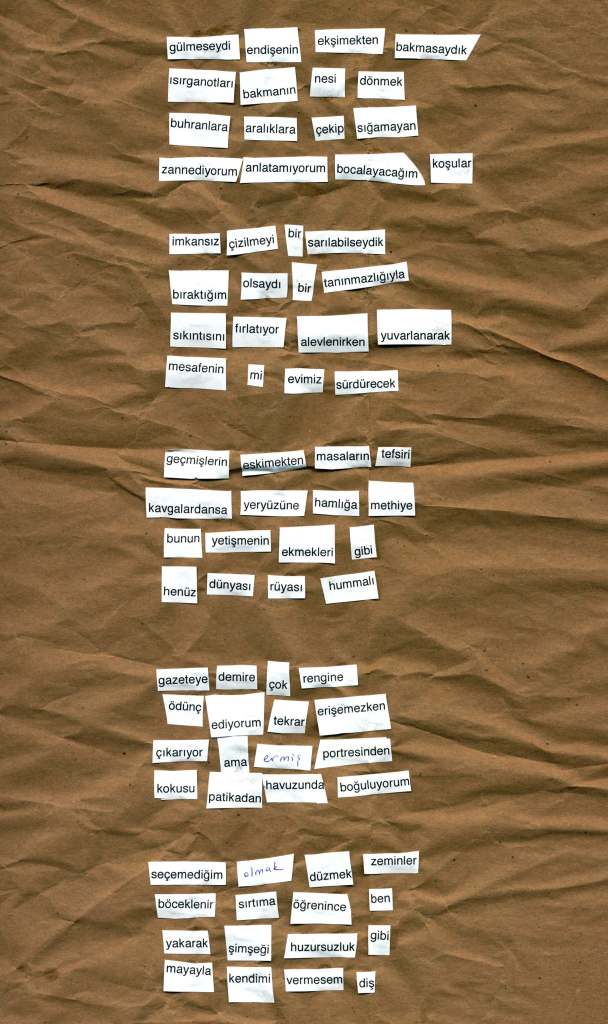
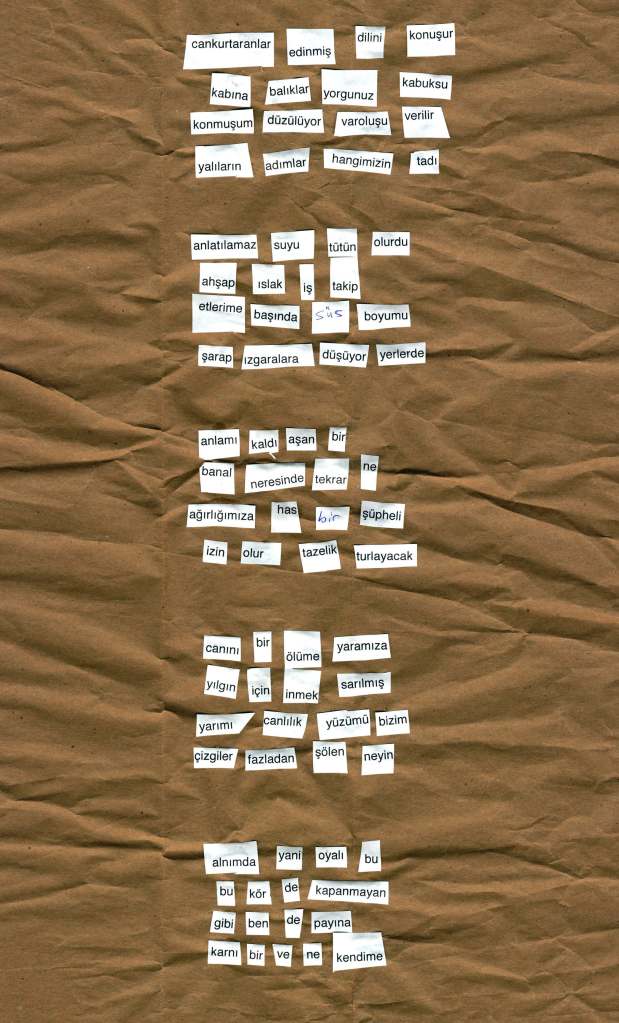
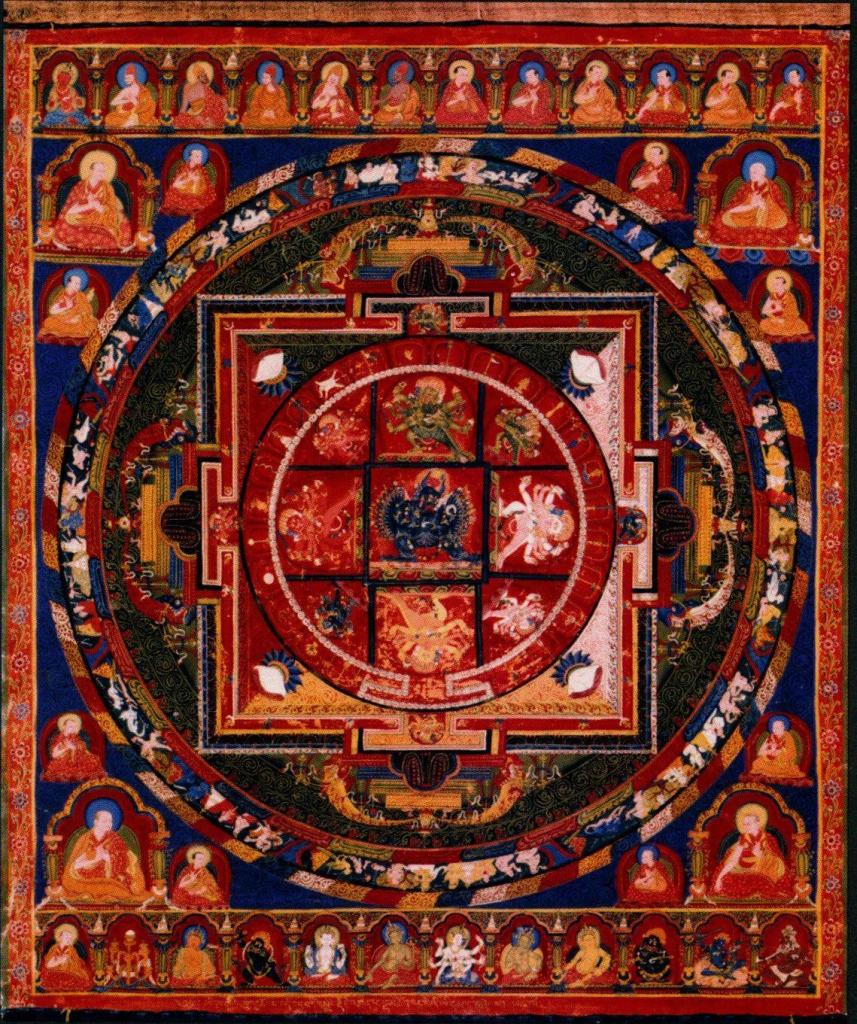
As I was searching for a file in the cloud drives I found this cut-up version of a poem I wrote back in 2016 January. The syntax is randomized, but one can sense the cloudiness I was in through the group of words. This one is only for the Türkiş speakers but there’s a magnificent mandala at the end that inspired the rhythm.
Julia Cameron’s cult found me back in 2016. I was extremely depressed, not that I need to explain but, after a mix of personal and political losses. I was probably googling things like “how not to be a loser” “how not to feel like you are losing all days” “how to function like a normal person” “how not to be sucked into the void of darkness and inertia…” Clicking through random sites, I found a blog (one of those shiny semi-fake self-development blogs with lots of ads) that mentions the “Morning Pages” with credit to Cameron. For some reason that I can’t still explain I was intrigued, found her website, found the pdf of her now-resurfacing book Artist’s Way, and started reading. She opens the book with the argument that there is something akin to religious belief in the process of writing, that God writes through you. For me, it was a leap of faith to even follow this 3-page-every-morning exercise. But I felt I had no better advice to pick myself off the floor anyways. Soon after I started, I was already having “revelations” about myself, finally going to therapy, and paradoxically energized by this weird action that in fact consumes some time and mental juice.
I continued a good while and preached the virtues of the practice (and Cameron’s book that has other exercises for creativity) to anybody who showed any inclination to follow through. Meanwhile I began working for my dissertation research; to save time, my morning practice became a freewriting on my cases and readings. After a (long) while I began working on a chapter directly, so the freedom of just putting words out there without censor went out the window. In fact, I became a bit fearful of this freedom, because there were times I felt it led me to mistaken conceptions, overenthusiastic conclusions, or elliptic ideas that are not useful for others but me. And I ran with them, sometimes. Perhaps mixing these two styles of writing was a mistake to begin with. I am still thinking about what happened when, how I produced what I did like, what did get in the way of being more efficient about academic writing.
When I returned home for the winter break two weeks ago, my dear friend (a Cameron convert, and one third of a “good life think-tank” that was the motivating source of this very blog) Murat gave me Cameron’s The Right to Write as a new year gift. Reading her writing on writing does feel like returning home. Especially now that I am going through a dull period as I try to finish this chapter, fill in its blanks, edit out its grandiosities and baseless verdicts. Until very recently I used to believe that I can only write in one medium and genre at a time, that this is my capacity. But perhaps I can write my dissertation, blog about artsy stuff, freewrite for chapters, and still do some personal writing in parallel. Not all at the same time, but I realize I just don’t need to pick one and lose the rest or substitute one for the other.
Last month I wanted to write here about Alla Kovgan’s Cunningham documentary I saw with Ryan and Andy. But somehow I got invested in it (or in blogging) in a high-stake way and my censor stepped in. Instead I told friends about the film, which is not bad but misses the point of reflecting in writing and discovering more. And now that I have a very fixed verbal script of my impression, I feel I can’t go further than that even if I attempted to write.
[…as a documentary-making the film doesn’t offer that much historic information, at least not more than what you could get by reading. The feat is the 3D filming of the major choreographies at stunning architectural sites. For the first time I understood (experienced? enjoyed) what Cunningham was trying to do. You really need to watch these choreographies like visual art, and for you to do that you need to get closer. The 3D renditions do exactly that. My brain and body were endlessly stimulated and I often found myself wanting to see more. The film underlines Cunningham’s self-description as a dancer first, and he created structures that he would enjoy dancing in at the end of the day. Perhaps drawing closer helps us feel that joy in a way we couldn’t on proscenium stage…]
pretentious performance critic, 2019
This entry was my bribe for going back to edits and final writings for the chapter. Before I leave, I want to put, without annotations, some words that I’ve encountered in the past 24 hours that have moved me to write this. Cunningham trailer at the end, hadi yine iyisiniz.
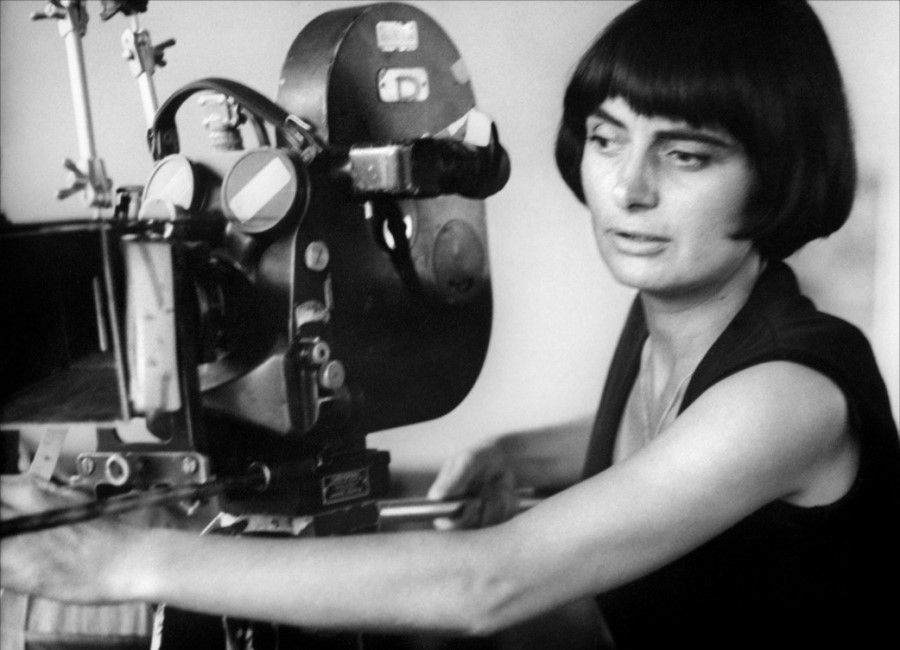
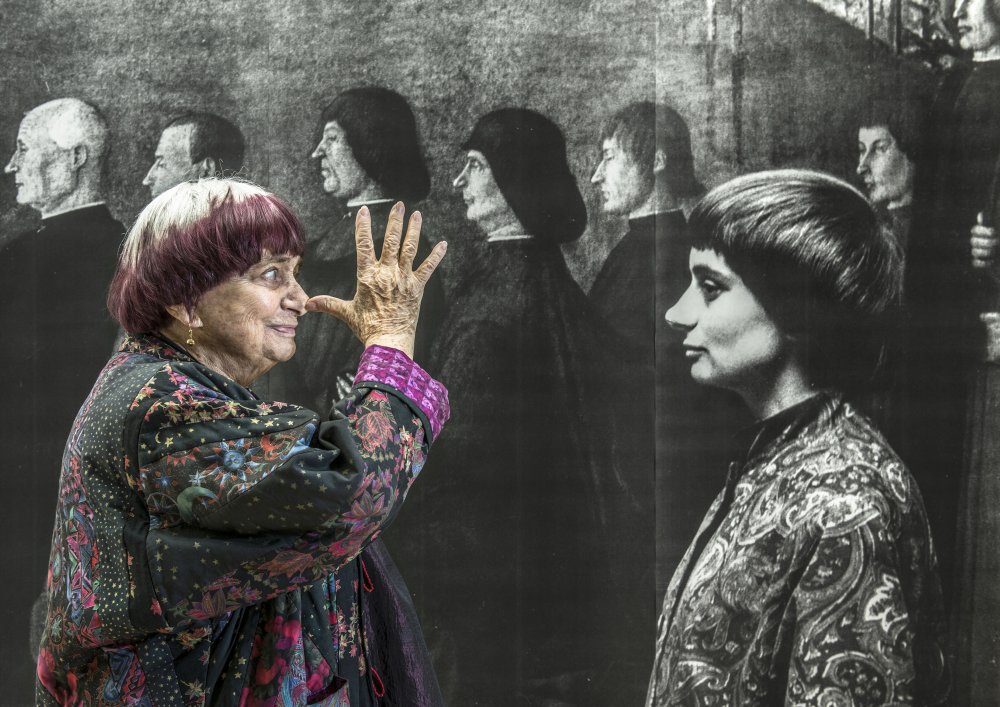
I have been wanting to write about Varda by Agnès since I saw it last Sunday, but kept postponing-being interrupted. The memory grows paler but the haunting is constant.
First off, a confession: I have never seen any Varda films. My knowledge of cinematic arts is very disorganized; all this time I knew I should watch her major works. But with films, I always do this weird delaying of the pleasure, wait until I have the right state of mind. With many serious directors, this habit proved to be useful–I wouldn’t appreciate Lynch a decade ago, for example. There are certain times and thresholds for artworks in general, they are not something readily available any time for our understanding. At least this is an idea of art I want to uphold.
Total babe. Also my homie from Ixelles and from her father’s side, “a Greek of Asia Minor.”
Luca, my neighbor-friend I invited at the last minute, jokes that we both will start watching her in reverse direction. This last film, quasi-chronologically revisits her artistic output, but not necessarily in order or in a catalogue fashion. The masterful narrator she is, Agnès walks us through certain politic-aesthetic trajectories of her filmmaking. Inspiration-creation-sharing, she says, are the three most central principles through and for which she makes films:
Inspiration, why you make a film; the motivations, ideas, circumstances, and happenstance that spark a desire and set you to make a film. Creation, how you make a film. By which means, which structure, alone or not alone, in color or not? Creation is labor. Sharing: You don’t make films to watch them alone, you make films to show them. Deep down, you have to know why you do this job.”
That is to say, sharing marks the intention and destination of the film, its power to communicate and create a community. As I listen to her, I have a moment of illumination. It becomes clear that for various reasons our generation of artists (cinematic, theatrical, otherwise…) is falling short in all of them. Instead of inspiration, we often find abstract problems, autobiographic obsessions, political needs for affirmation or redeeming guilts at best. As to creation, we have terrible habits of turning to familiarity and cutting corners because time, places, money, other artists’ goodwill are too limited to give yourself in to the luxury of trying things. But perhaps more truthfully, the failure comes from the combination of the overwhelming amount of choices, the infuriating ignorance of critical thinking and aesthetic tools, the avoidance of dialogic process of asking questions and reflecting on the process. Sharing: The meaning of that very word has changed so much with the online culture that I am now not sure it connotes the same as Agnès meant it. Sharing requires a context of generous as well as critical care and attention. Places and times to do so are too accelerated and shrunk, literally virtualized, to allow for that. I do know of people trying to resist this and carve out their niches, and they succeed in varying degrees, at least to let them keep going for a while. But I am not sure how much of sharing and how much of surviving there is to it.
A moment in which I found myself leaning towards the screen at the edge of my seat with excitement was when she was discussing her film Vagabond. She breaks down the long sequences of continuous movement, why she chose a certain direction of camera and plan, what we see and what kind of a puzzle that is. She doesn’t explain any deeper “meaning,” she just frames and points out what we are seeing, and gives form and energy to our way of looking at it. For the sake of not spoiling it for you, I will leave it at that it was the best lecture for what dramaturgy means. Granted, she is doing it in reverse. But like her explanation of “creation,” Agnès’ artfulness is in testing and tying the choices out of infinity, which speaks sometimes fluently and sometimes cryptically.
Also during the section on Vagabond, she talks to Sandrine Bonnaire about how she acted that part. Without psychologizing the character, but coming close to the embodied approaches of method acting, Agnès asks her to go through and find her way out in the precarity of being angry and on the road without direction. We see a woman passing time and passing swathes of far from idyllic earth, Agnès tells us. Everything is extremely objective, her body moving in the places, encountering things and persons that draws her or that she pushes away. There are the material conditions of life in abandon and the necessity to figure out how to continue, and these bind the actor as concretely as the character she is presenting. Either a fiction film or a documentary, what she shoots is wondrous, sensuous (especially the music and the colors!), and demystifying all at the same time.
Another thing that made me catatonically shake in my seat is the crystallizations of her joy, how she continues playfully and with good humor. When she creates a feminist song with Marx’s lyrics, when she is choosing the heart-shaped potato for herself during her Gleaners, while she is burying her beloved cat, while she is losing her eye sight… I took it as her parting gift and lesson to younger generations (of artists, feminists, rebels, lovers, gleaners…) for how to live on ethically, that is, how to live a good life despite knowing full well that the world is unjust, violent, irrational, greedy, and rushing suicidally to its annihilation.
Luckily the release of the film also occasions a series of retrospective screenings, so I will now make up and go deeper with all the little signs she left for us to mull over in her films, some of which, she giggles, “are only for her to know.”


 Eylül Fidan Akıncı
You must be logged in to post a comment.