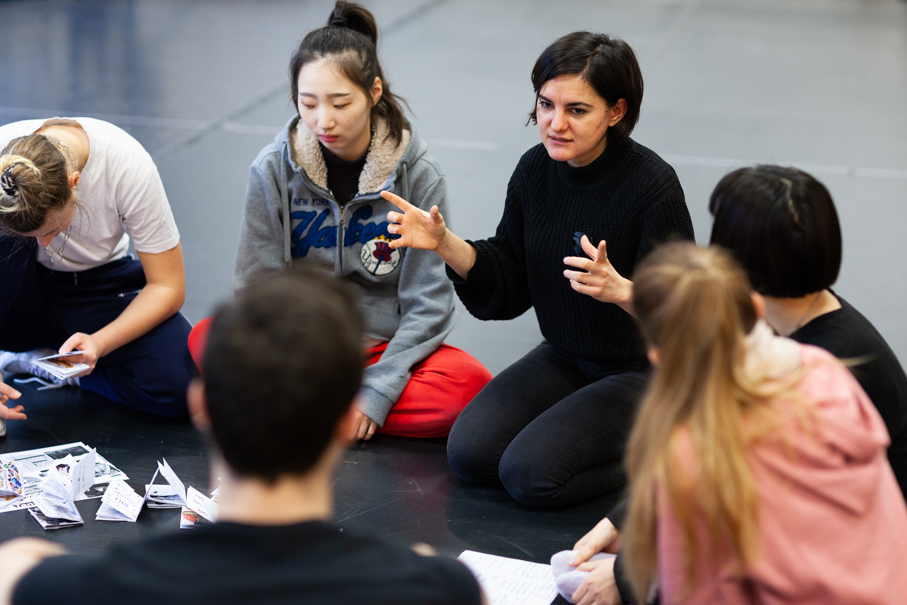
I have prepared and taught workshops, undergraduate semester-long classes, crash courses, master seminars, as well as graduate-level advisement sessions.
Contact for more information, syllabi, and teaching inquiries.
What Is Contemporary?
What Is Contemporary? is an inquiry into historicizing, categorizing, and valuing dance. The course unpacks what the “contemporary” qualifier explains or hides when used as “contemporary dance,” “contemporary ballet,” or—even more puzzlingly—”contemporary performance” in relation to predominantly embodied and choreographic works and practices. We question why contemporaneity swings between signifying a temporal blur, novelty, presentism, visionary aesthetic, or ethical value. We approach “contemporary” as a generative problem symptomatic of the Western modernity project and its reaction to “tradition” at large. We situate “contemporary” as a conceptual escape route within the contentions of globalization and late capitalist economy, race and ethnicity, gender and sexuality, avantgardes and popular cultures, and normativity and disability. Finally, the class arrives at functional, demystified, and capacious revisions of what else “contemporary” may be.
Articulating & Activating Ecodramaturgies
I am developing two interrelated seminars, Articulating Ecodramaturgies and Activating Ecodramaturgies, as itinerant investigations that have grown out of my dissertation. The first seminar focuses on theorizing, historicizing, and discoursing with science on ecocriticism in performing arts. The second seminar follows up on this conceptual effort and speculates on its practical, public, physical, and poetic expanses. Invited artists, activists, researchers, and stakeholders who focus on performative aesthetics and justice for more-than-human environments are part of this collective research.
Dramaturgy for Directors
Designed to articulate the historical and practical connections between directing and dramaturgy, this course overviews key dramaturgical strategies across Western and Global South performances, the shifting positioning of the audiences, and the critical role of theatre in societies past and future.
Dance Dramaturgy
This course surveys the nascent literature of dance dramaturgy, to arrive at the “choreo-dramaturgy” method that I have coined and employed in my dissertation. I draw from my own decade-long practice as a dance dramaturg to bridge theory and practice and support the artistic research of students. We look at dance dramaturgy from the axes of embodiment, time, and space, by both approaching them analytically from cases and testing in improvised studio practice.
Global Theatre Histories
This course expands on the theatre history beyond the Western canon. Criss-crossing the ancient and medieval theatres of Europe and decentralizing the primacy of play text, we comparatively study the performance traditions and stage technologies of East and Southeast Asia, the Middle East, West Africa, and Latin America.
Dance and Identity
This artistic research course introduces students to the intersections of identity and embodiment via the critical theories of biopolitics, race, sexuality, and ability. We visit the founding mothers of dance ethnography and get a taster of pioneering research in global dance studies. The students are then guided to investigate their own creative identity in somatics and dance.
Dance Herstories
Instead of lecturing on various histories of dance, the course invites the participants to reflect on their own knowledge of dance history, questioning both terms, and expanding it with non-normative definitions of body, movement, and musicality. It mobilizes the students’ implicit knowledge of concert stage, ethnographic, and popular dance forms.
Concept Development
I have designed this 4-hour module for Muziektheater students of ArtEZ. The intermedial and devised nature of the nascent Muziektheater genre calls for a more rigorous expression of dramaturgical methods and goals. By drawing from experimental cinema, contemporary dance, drag scene as well as American musical theater, we identify muziektheater’s unique qualities and opportunities for development in the broader performing arts field. Students are then guided to define their ambitions and performance concepts, producing multiple drafts and giving guided feedback to each other.
Voice | Text | Movement
I teach open-level workshops on spoken poetry, exploratory writing, and Viewpoints-based improvised movement.
Public Speaking
As much as teaching the psychological and physical techniques of public speaking, this course is a guide on how to conduct research for oral presentations, formulate compelling arguments, analyze facts and logic, use new media and digital resources critically, and harness the power of user-broadcasting tools.
Further
My other teaching interests include expanded scenography, performing objects and technologies, intermedia and artificial intelligence on stage, political theatre and performance, and postmodern dramatic literature.
Eylül Fidan Akıncı is part of a researcher-lecturer cohort from Theatre and Performance program of The Graduate Center-CUNY, still conspiring to innovate curriculum for expanding and decolonizing the performing arts education.





 Eylül Fidan Akıncı
You must be logged in to post a comment.